So you want to use Anki to level up your language learning. You’ve decided that you don’t want to spend valuable study time creating thousands of cards yourself, so you’re looking for a premade deck.
There are hundreds of shared decks on AnkiWeb, but their quality varies enormously. Some are carefully structured courses. Others are little more than frequency lists turned into flashcards, with unnatural example sentences, inconsistent difficulty, or no clear grammar progression.
So how do you tell the difference?
Based on years of using Anki and creating language-learning decks, we’ve identified five fundamentals that we think every good deck should get right, plus four nice-to-haves that can make a good deck even better.
The five fundamentals concern the underlying learning material. If they’re weak, fixing a deck often means rewriting or reorganizing a substantial part of it. The nice-to-haves matter too, but they’re generally easier to add or improve.
Analyze any Anki deck with our free AI tool
Our Anki Deck Analyzer uses AI to evaluate decks against the nine criteria explained in this article. It gives you a structured assessment of a deck’s strengths and weaknesses, along with an overall score.
Download the Anki Deck AnalyzerWindows & macOS · needs an Anthropic API key
The tool is free, but you’ll need an Anthropic API key with credit to run it. A full analysis typically costs around $0.40–$0.70 in API usage.
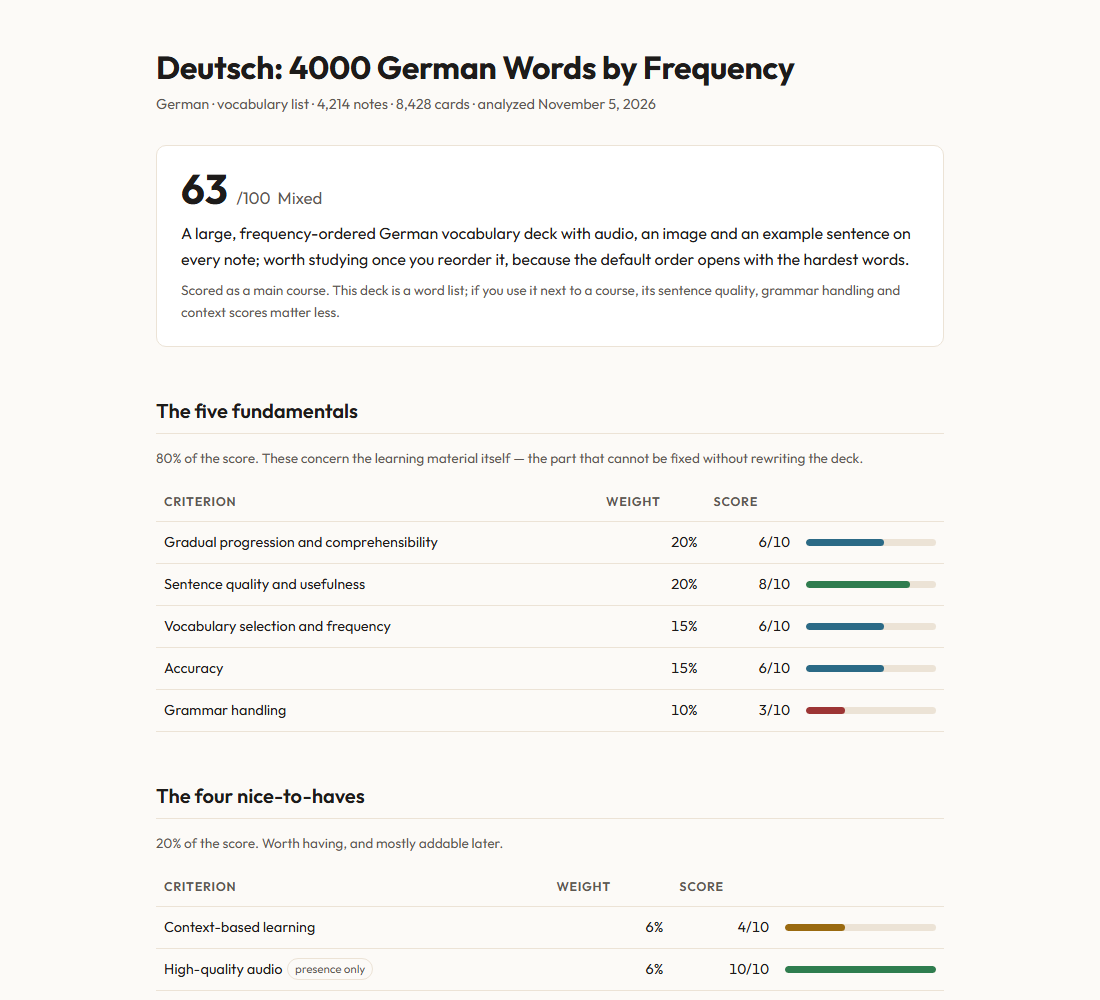
Don’t want to run it yourself? We’ve already put the most popular decks for several languages through the analyzer and published the top 10 for each. See the rankings.
Below, we explain the criteria behind the analyzer, how they’re weighted, and what to look for when choosing a deck yourself.
The 5 fundamentals
A deck doesn’t have to be perfect in every category, but if it performs poorly in several of these, we’d keep looking.
1. Gradual progression and comprehensibility 20% of the score
A good deck should get harder gradually.
This sounds obvious, but many premade decks fall short here. A frequency-based deck, for example, may teach common words while placing them inside sentences full of unfamiliar vocabulary and grammar.
Ideally, new sentences should mostly consist of language you already understand, with only a small amount of new material introduced at a time.
This is related to Stephen Krashen’s idea of i+1: input should remain understandable while introducing something slightly beyond your current level.
When evaluating a deck, check sentences from different parts of it. Does the difficulty increase gradually, or do you regularly encounter material that feels far beyond what came before?
Sentence cards that add at most one new word
- FSI Spanish · progression 8/10
- German Top 4000 · progression 6/10
Show the numbers
| Tenth | FSI Spanish | German Top 4000 |
|---|---|---|
| 1 | 91.1% | 24.1% |
| 2 | 95.8% | 54.5% |
| 3 | 98.2% | 58.7% |
| 4 | 97.5% | 57.0% |
| 5 | 96.7% | 63.5% |
| 6 | 97.1% | 57.2% |
| 7 | 98.7% | 68.6% |
| 8 | 97.3% | 63.3% |
| 9 | 95.4% | 72.7% |
| 10 | 86.2% | 66.7% |
2. Sentence quality and usefulness 20% of the score
A sentence can be grammatically correct and still be a poor learning sentence.
It may sound unnatural, contain unnecessarily obscure vocabulary, or describe situations that are unlikely to be useful.
Good learning sentences should be:
- natural
- appropriate for the learner’s level
- useful for understanding the target word or grammar point
- representative of how the language is actually used
This matters because you may review the same sentence dozens of times.
We also prefer decks that make sentences a meaningful part of the learning process rather than treating them as decoration underneath isolated vocabulary.
Ultimately, the goal is not just to recognize words but to understand language.
3. Vocabulary selection and frequency 15% of the score
Not all words are equally useful.
High-frequency vocabulary usually gives you more value early on than rare or specialized words, which is why frequency lists are a useful starting point.
But frequency should not be followed mechanically.
A well-designed deck should prioritize vocabulary that is both common and useful at your current level. Sometimes a pedagogically important word deserves to appear earlier than its exact frequency ranking would suggest.
So instead of asking whether a deck follows a frequency list perfectly, ask:
Does this deck teach useful vocabulary in a sensible order?
If obscure words appear before basic everyday vocabulary, that is usually a warning sign.
4. Accuracy 15% of the score
You need to be able to trust what is on the cards. Look for:
- correct target-language sentences
- accurate translations
- correct gender and plural information
- correct conjugations and declensions
- reliable grammar explanations
- consistent spelling and punctuation
Even a carefully designed deck may contain occasional mistakes, but frequent errors are a serious problem.
AnkiWeb reviews can help here. If several users point out recurring translation or language errors, take that seriously.
5. Grammar handling 10% of the score
As soon as you start learning sentences, you are also learning grammar.
A good deck should therefore introduce grammar in a reasonably structured way instead of exposing you to random constructions with no progression.
Ideally, new grammar builds on structures you have already seen. Several nearby sentences may reinforce the same pattern, making it easier to notice how the language works.
Dedicated explanations, grammar cards, or tables can also help, although they are not essential if the deck handles grammar well through its sentence sequence.
Ask yourself:
Does the grammar build step by step, or am I constantly encountering structures that have never been introduced?
Three cards in a row, one grammar point · grammar 8/10
The 4 nice-to-haves
The following features can significantly improve a deck, but we wouldn’t reject an otherwise excellent deck simply because one of them is missing.
1. Context-based learning 6% of the score
Language becomes more meaningful when it belongs to a larger context.
An isolated sentence gives you more context than a single word. A dialogue, story, lesson, or recurring situation can provide even more.
For example, a deck might introduce a short dialogue and then break it down into individual sentences, vocabulary, and grammar cards.
A deck can also get its context from an external source such as a textbook, video course, or TV series.
Context is not essential for every card, but it can make new language easier to understand and remember.
2. High-quality audio 6% of the score
Listening is an important part of language learning, but the audio does not necessarily have to come from the deck itself.
Having clear audio directly on the cards is highly useful. Native-speaker recordings are excellent, and modern high-quality text-to-speech can also work very well.
However, we classify audio as a nice-to-have rather than a fundamental because it is relatively easy to add yourself.
With Anki add-ons such as HyperTTS, you can generate audio for an otherwise excellent deck. Fixing poor progression or thousands of unnatural sentences is much harder.
So missing audio should count against a deck, but it does not necessarily make the underlying learning material bad.
3. Card design and study usability 5% of the score
You may see the same cards every day for months or years, so usability matters.
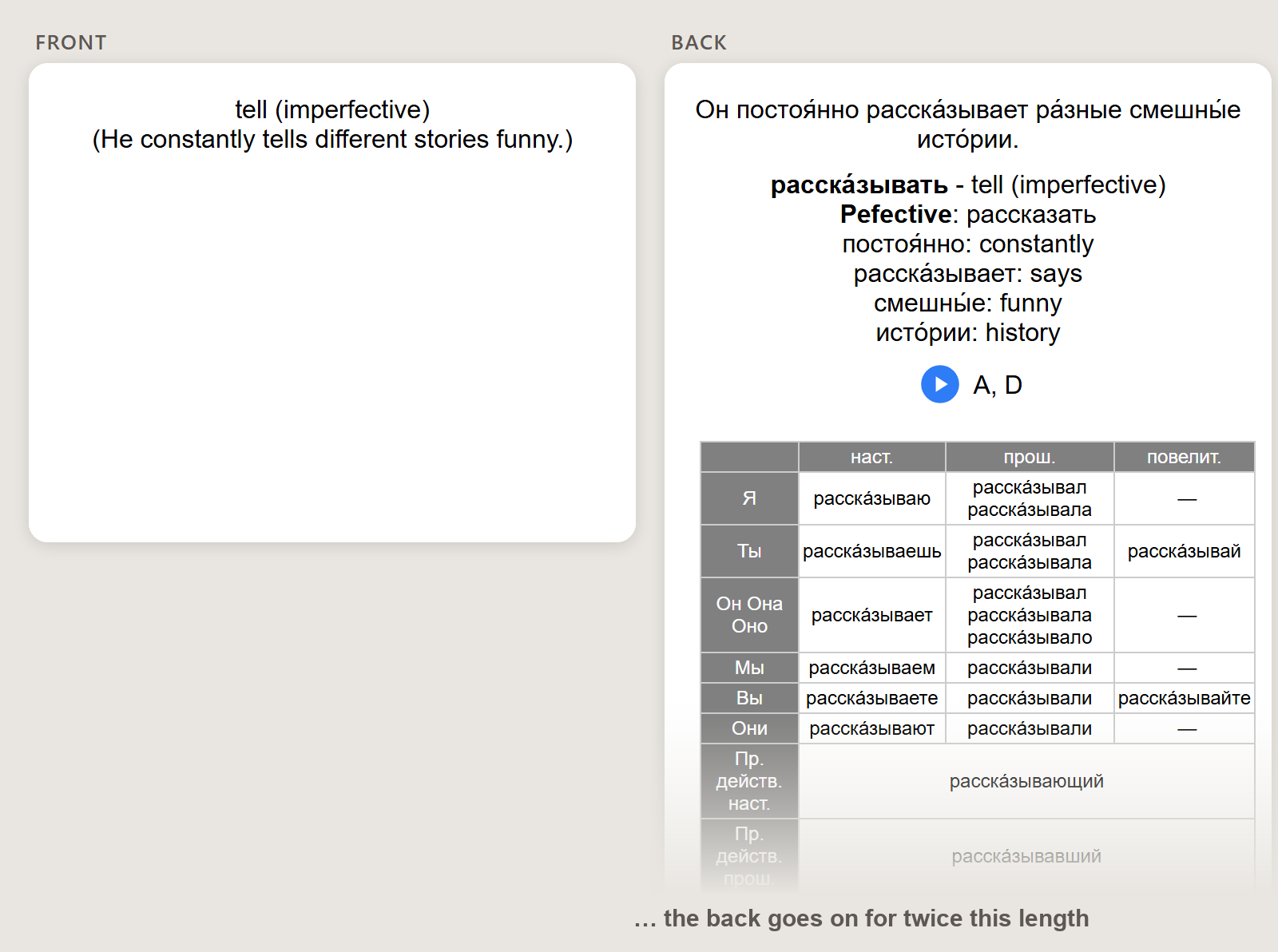
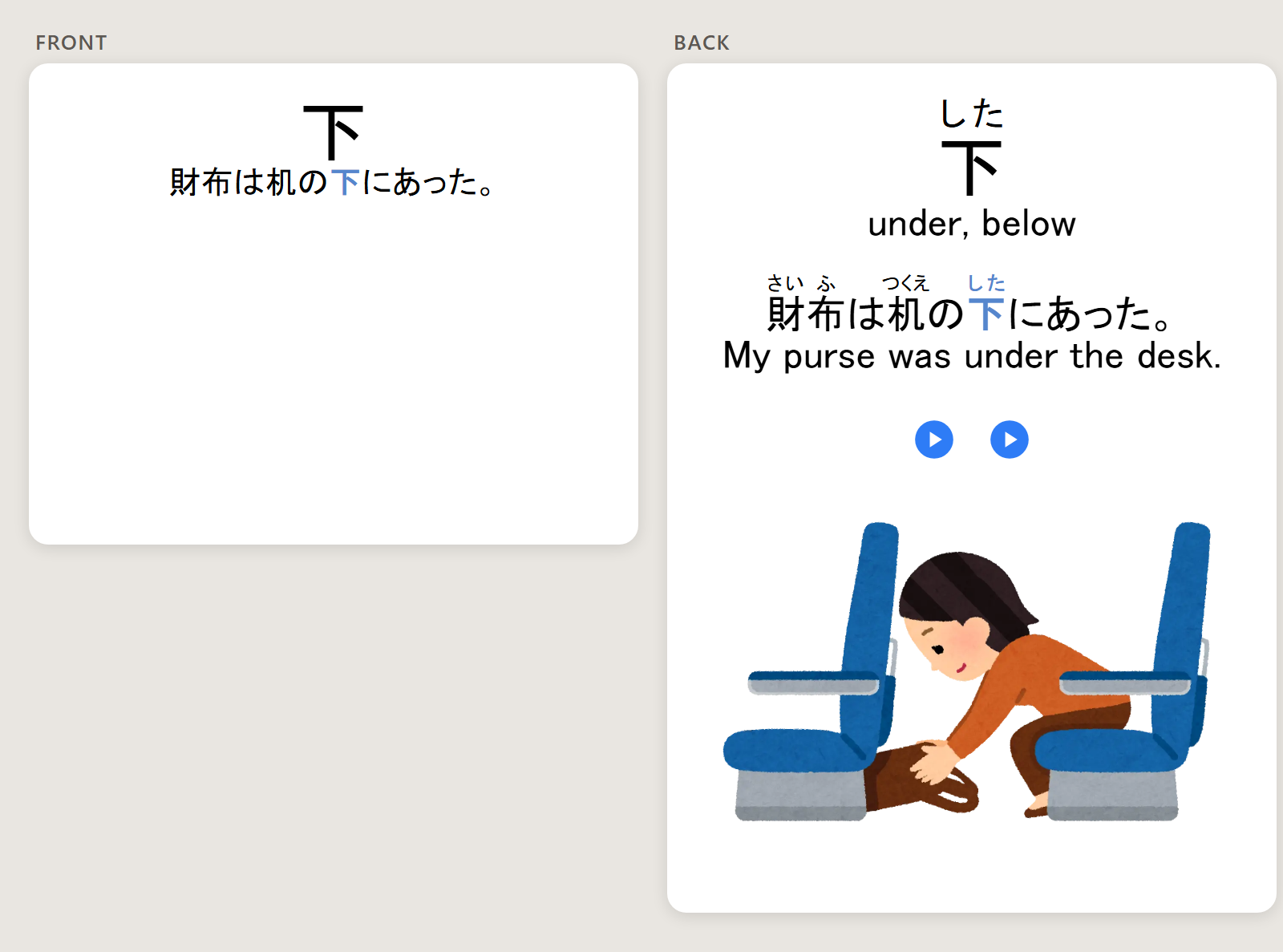
A well-designed card should make it immediately clear what you are supposed to recall. The answer should be easy to evaluate, and important information should be separated from optional details.
An unclear card and a clear one, front and back
Top 5000 Russian Verbs card design 5/10
Kaishi 1.5k card design 8/10
Poor card templates are also relatively easy to fix. Anki card templates can be redesigned without changing the underlying notes.
For that reason, card design matters, but it should not outweigh the quality of the learning material itself.
4. Images 3% of the score
Images can make reviews more enjoyable and create an additional connection to the meaning of a word or sentence.
They are particularly useful for concrete vocabulary such as objects, food, animals, places, and actions.
They are less important for abstract vocabulary, grammar, and many longer sentences.
We therefore see images as a useful bonus rather than a requirement.
Other helpful features
A few additional features can make a good deck even more convenient:
- Subdecks: Useful for studying one section at a time or skipping material you already know.
- Grammar tables: Especially helpful for languages with extensive conjugation or declension.
- Card variety: A mix of cloze cards, vocabulary cards, and dedicated grammar cards can make reviews less repetitive.
- Selective active recall: Translating into your target language can be useful, but doing it for every sentence may become tedious.
- Useful notes and explanations: Short explanations can clarify difficult grammar or vocabulary without overwhelming the main card.
These features are useful, but they are not part of our weighted rating.
How to evaluate a deck yourself
You don’t need our analyzer to judge whether a deck is worth using. A quick manual review can reveal a lot:
- Look at cards from the beginning, middle, and later parts of the deck.
- Check whether the sentences sound natural and the difficulty rises gradually.
- Ask whether useful vocabulary appears early.
- See whether grammar builds logically.
- Skim negative reviews for recurring accuracy issues.
- Check whether the card design, audio, and overall format are something you’d actually want to use every day.
The Languages on Fire decks
We use the same principles when designing our own decks.
When I started looking for premade language-learning decks in 2020, I struggled to find decks that combined useful vocabulary, gradual progression, natural sentences, grammar, audio, and meaningful context.
So I started building my own.

Today, Languages on Fire decks are designed as complete language courses inside Anki. Depending on the language, they use dialogues, stories, or existing courses to provide context while breaking the language down into manageable cards.
Our trial decks are available on AnkiWeb, so you can test the approach yourself and decide whether it works for you.
Languages on Fire decks:
- Spanishfree trial on AnkiWeb
- Frenchfree trial on AnkiWeb
- Italianfree trial on AnkiWeb
- Germanfree trial on AnkiWeb
- Russianfree trial on AnkiWeb
- Czechfree trial on AnkiWeb
Our Anki deck reviews
We’re ranking the most popular Anki decks for each language with our analyzer. The rankings so far, with more languages to come:
- The 10 best French Anki decks (2027)
- The 10 best Spanish Anki decks (2027)
- The 10 best Russian Anki decks (2027)
- The 10 best Portuguese Anki decks (2027)
- The 10 best Turkish Anki decks (2027)
- The 10 best Korean Anki decks (2027)
Rather than relying only on AnkiWeb ratings or download numbers, we examine the actual learning material and score each deck using the framework above.
The best deck is ultimately the one that fits your level, goals, and preferred way of learning.
But if the vocabulary is useful, the sentences are natural, the progression makes sense, the information is accurate, and the grammar builds logically, you have already covered the parts of a deck that are hardest to fix later.
Everything else can make a good deck better.