“It's really relieving when you know there are professionals behind all the decks, so you don't worry for the inaccuracy or wasting time on some rare vocabulary when starting.
Personally I'm doing the decks with the textbook "Grammatik aktiv", at the pace of roughly one class a day and 25-35 words a day. You can often see the grammar you just learned to show up in the anki sentences, or a new grammar in a sentence you just asked AI to break down to show in the textbook. Amazing review and reinforcing experience.
Yet there are a few errors I encountered, but overall, still absolutely worth the money, to save so much efforts for beginners.”
Learn German like a pro.

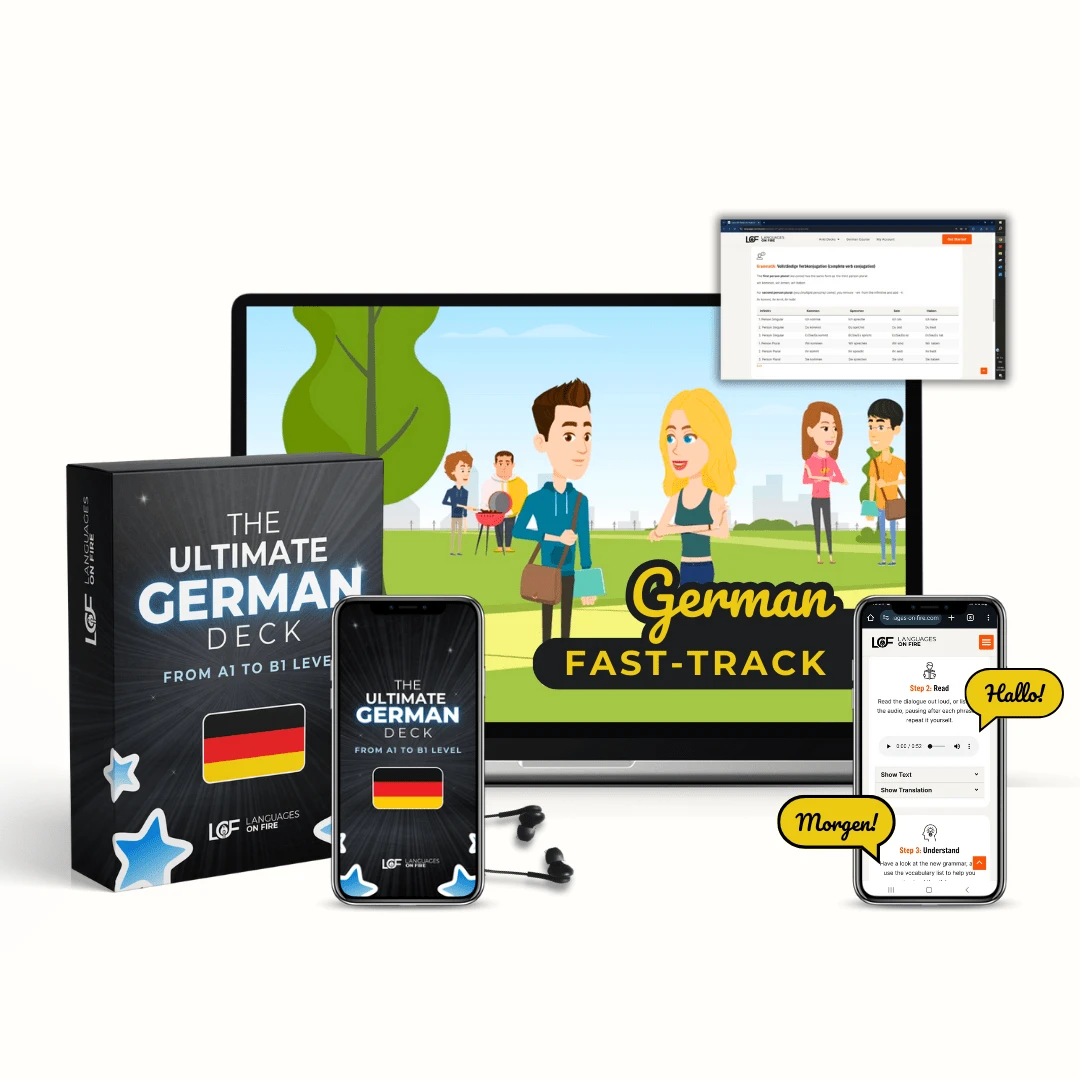
Follow Anna and Max through 21 lessons of everyday German, learn 1,000 high-frequency words, and let Anki make sure you keep them.
The Deck €29.99 · The full course with all 21 lessons €69.99
From your first Hallo to everyday conversations
The lessons come with the full course. Everything else is in both packages.
21 lessons · A1→B1+
Short videos built around everyday dialogues, so you learn German in real, natural context.
Native-speaker audio
Every sentence recorded by native speakers, so you train your ears — and your pronunciation — on real German.
The 1,000 words that matter
Frequency-ordered, so the words that carry most of everyday conversation come first.
2,000+ Anki cards
A story-based deck that locks in every lesson's vocabulary and grammar for the long term.
Learn through everyday German
You'll follow Anna and Max, two young students in Munich, as they navigate daily life and a budding romance across 21 lessons, from your first Hallo to confident, everyday conversations. Every sentence arrives with native-speaker audio and a picture, so you've heard it and seen it before you have to say it.
- Everyday dialog, the German people speak
- The most common words first, ordered by frequency
- Native audio on every sentence, and a picture on nearly every card

Five steps that make German stick
Every lesson follows the same rhythm. The deck is step 5, and it comes with both packages.
Watch
A short animated video with an everyday dialog.
Read
Read the dialog aloud, or listen and repeat after each line.
Understand
Check the new grammar and vocabulary behind it.
Practice
Lock it in with interactive quizzes and exercises.
Memorize
Burn the words and phrases in with the Anki deck.
In both packages
Plus: the Study Playbook
Your step-by-step guide to studying smarter. Build a routine that sticks, use Anki the right way, and make consistent progress without burning out. Yours with either package.
- How to build a daily habit that survives a busy week
- The right way to use Anki (and the settings that matter)
- How to turn passive review into speaking ability
- A simple roadmap from your first words to fluency
Memorize with the deck, or learn with the full course
Both include every card from all 21 lessons. The full course adds the lessons that teach them.
- Every word and sentence from all 21 lessons: 2,000+ cards, A1→B1
- Native-speaker audio, and a picture on nearly every card
- The Study Playbook (PDF)
- 30-day money-back guarantee
- The lessons, grammar and quizzes are in the full course
- Everything in The Deck
- 21 lessons (A1→B1+) with short videos
- Grammar explained lesson by lesson
- A quiz for every lesson
- 30-day money-back guarantee
Want to try first? The free deck on AnkiWeb is the first six lessons, 464 cards, and lesson 1 of the course is free on our site. Your Anki progress carries straight over if you buy.
Why Anki-powered learning beats the apps
Minimize study time, maximize retention
Spaced repetition shows you each card exactly when you're about to forget it — the most efficient way to remember for the long term.
Learn what you need first
Word-frequency ordering means you spend your time on the language you'll use, not rare words an app throws at you.
Full control, forever
It's your course. Study offline, at your own pace, with no subscriptions and no algorithm deciding for you.
How it compares
| LoF course | Standard apps | Other Anki decks | |
|---|---|---|---|
| Efficiency | ✓ | (✓) | (✓) |
| Long-term retention | ✓ | — | ✓ |
| Full control | ✓ | — | ✓ |
| Everyday dialog | ✓ | (✓) | — |
| Native-speaker audio | ✓ | ✓ | (✓) |
| Word-frequency order | ✓ | — | (✓) |
| Lessons + grammar (full course) | ✓ | (✓) | — |
What learners say
Verified reviews from learners using the German deck and course.
“Languages on Fire has been a game-changer in my German learning journey! As a medical student aiming to work in Germany, their Anki decks and community support have been invaluable.”
“This is probably the fastest way to fluency in German. It is even more wonderful when paired with the course.”
“A very dialogue-oriented course after completing which you'll be able to use German in usual life situations. Using this course feels very rewarding.”
Already studying with Languages on Fire German? We'd love to hear how it's going.
What learners say
“I regret purchasing the German deck.
I bought it expecting a useful vocabulary-focused Anki deck built around the most common German words. Instead, I received 2,000+ cards consisting of vocabulary cards, recall vocabulary cards, sentence cards, and recall sentence cards. I was looking for a relatively compact vocabulary foundation that I could use before moving into immersion, not thousands of cards requiring me to memorize entire sentences.
The sentence-recall cards were especially frustrating because they are based on the German course's video lessons, but the videos are NOT included with the basic German deck. Languages on Fire describes its German method as “Watch → Read → Understand → Practice → Memorize,” with the Anki deck being the memorization step. Without the videos, however, I was often being asked to recall sentences that I had never actually learned through the context the course was designed to provide.
As a result, I ended up brute-forcing many of these sentences in Anki instead of learning naturally from the material. I don't think sentence-recall cards are inherently bad, but if they are built around video lessons, the videos should be included with the deck or the product should clearly explain that the deck is intended to be used as part of a much more expensive course.
There are also several quality issues I encountered, including missing images, English typos, and recall cards where it isn't always clear whether the expected German answer is formal or casual.
The value proposition is another major problem for me. The German deck costs about $30 USD, but the 21 German video lessons require the $70 USD full-course package. I do not want coaching, tutoring, quizzes, or a larger course ecosystem. I wanted a standalone deck I could use to learn vocabulary and then move into immersion.
What makes this especially frustrating is that Languages on Fire's other language offerings can provide substantially more material and access to associated video content at the same or lower price. For example, the French offering is built around French in Action and the associated video course is freely available, whereas the German videos are locked behind the much more expensive package. As a German learner, I feel that the German standalone deck has a significantly weaker value proposition.
The marketing also gave me the impression that I was buying a resource centered around 1,000 common German words, but the actual deck contains more than 2,000 cards because the same learning material is split across multiple card types. That distinction should be much clearer before purchase.
This may work well for someone who specifically wants the full Languages on Fire methodology and is willing to pay for the complete course. For someone who simply wants a good standalone German vocabulary deck, however, I would not recommend it.
I would not purchase the German deck again.”
Dear Michael,
Thank you for taking the time to share such detailed feedback. I'm sorry the deck didn't meet your expectations.
The German deck is designed to build exactly the kind of vocabulary and comprehension foundation you describe, preparing learners for immersion. We encourage learners to suspend cards liberally according to their goals. If your main focus is comprehension, you can suspend the sentence-recall cards and concentrate on understanding vocabulary and sentences.
While some learners are happy using the deck on its own, we recommend combining it with the video course for the most comprehensive learning experience. Our free trial on AnkiWeb gives learners a chance to try the standalone deck before purchasing. That said, your feedback shows that we could communicate the different learning options more clearly, and we'll review our website accordingly.
We've since simplified our offers and no longer bundle coaching with our products.
We're currently working on a major quality review of the German deck. If you could share specific examples of the issues you encountered through our contact page, we'd greatly appreciate it.
Thank you again for your feedback. It helps us improve our products and how we present them.
Best regards,
Christian
“Languages on Fire has been a game-changer in my German learning journey! As a medical student aiming to work in Germany, their Anki decks and community support keep me motivated daily. Highly recommend it to serious learners!”
“good”
“I really liked the German course because it is very complete, it shows a story, and you can hear the pronunciation, and see the written dialogue and at the end there are comprehension questions, there is also useful information about grammar and with anki I can learn and practice new vocabulary :)”
“This is probably the fastest way to fluency in German. It is even more wonderful when paired with the course.”
“I have been using the demo Anki deck https://ankiweb.net/shared/info/1698672280 for more than a month and I have to say it's the best I have encountered. There is not a single audio missing and I really feel like learning is FAST. I am not a person that usually spends money online but I had to get the course and I must say it's worth every cent.”
“What I liked most about the course is that it gives useful conversations in everyday life because through the videos you can listen to the correct pronunciation of the key words or phrases of the lesson, as well as providing the written conversation and answering some questions from the video to confirm that it was understood, if not, you detect which words you need to review more and that is where Anki helps a lot because it reaffirms what you learned from the lesson giving the vocabulary again with the audio as many times as necessary and until it is understood.
I think it is a good method to learn languages, reinforce them and use them in life, I really recommend it.”
“I enjoyed the German language course. It provides a comprehensive and engaging learning experience for newbies. The structured syllabus, multimedia resources and interactive approach ensured effective learning.
In terms of accessibility, the course was excellent. Whether from a desktop computer or mobile device, one can seamlessly work through the course material anytime and anywhere.
It is also convenient that this course gives flexibility for self-study, especially beneficial for people with busy schedules, allowing them to study at a convenient time.
I also liked the cards for memorizing words and sentences, very convenient thing, you can study both from the computer and from your phone at any convenient time.
What I would like to add is more practical tasks. For me personally, the more I do tasks the faster I memorize new knowledge.
I highly recommend it to anyone who is starting to learn German.”
“Muy buen curso me ha servido bastante para aprender y ahora siento mas confianza al momento de conversar.
10 de 10 súper recomendado.”
“A very dialogue-oriented course after completing which you’ll be able to use German in usual life situations. Using this course feels very rewarding, because after each lesson you learn something useful. Noy only vocabulary and idioms, there are bits of popular culture sprinkled all over this course. Conversations are realistic, a bit more nuanced than in other books, which I think is good overall. Videos are entertaining, voice acting is genuine and easy to follow. After watching the video at normal speed, I always listened to the dialogues again at a bit slower speed and tried to repeat the sentences. Vocabulary lists and Anki flashcards are provided for every lesson. They ensure that you’ll come out after every lesson with new knowledge memorized. It is important to practice regularly for this model to work its magic.
I think this course is well-made and can be implemented into your study routine to make it more varieds. Because this course is very conversation-oriented, it is best combined with a grammar book to develop all your language skills at the same time. Can recommend it.”
“I used the Languages on Fire deck to bring order to my learning. I didn't have time to participate in a course, so I needed a structure for my learning. I began learning German after a few months of stay in Germany, and in the beginning, there were lots of things to learn to become able to communicate in a basic everyday life. This deck helped me to prioritize.
It was also my first experience with Anki. The deck helped me to commit to a daily basis practice.”
Frequently asked
What's the difference between the two options?
The Deck is every word and sentence from the 21 lessons, with audio and pictures, in lesson order. It's built for memorizing, so it doesn't explain the grammar.
The full course adds the 21 lessons themselves: short videos, grammar explanations and a quiz for every lesson.
If you want this course to teach you German, get the full course. If you already have a teacher, a class or a textbook and want the words and sentences in Anki, the deck is enough.
Is this a vocabulary deck or a sentence deck?
Both. About half the deck is single words (nouns with their gender, verbs with their forms) and the other half is sentences from Anna and Max's story, which is where the words get used. That's what makes it a course rather than a word list. If a short word list is all you're after, this is more than you need.
Why 2,000+ cards if it's about 1,000 words?
The deck has about 1,100 notes. Most of them make two cards: one shows you the German and asks for the meaning, the other shows you the English and asks you to produce the German. The second kind is harder, and it's the one that builds speaking.
You decide how much of that you take on. To start with recognition only, open Anki's Browse window, search card:2, select everything and choose Suspend. You can switch them back on whenever you like.
Can I try it before I buy?
Yes, both parts. The free version on AnkiWeb is the first six lessons of the deck, 464 cards in exactly the format you'd be buying. And lesson 1 of the full course is free on our site, video included.
Why shouldn't I use another free Anki deck?
You can, and a few of them are decent. The differences that matter are structure and context. Most free decks are word lists or unconnected sentences, ordered by whatever the author had to hand rather than by how common a word is. This course follows Anna and Max through 21 lessons, so every sentence arrives in a context you can hang it on, and the vocabulary is ordered by frequency, so the words that carry most of everyday German come first. Every sentence is recorded by native speakers. If you want a second opinion before you decide, the reviews on AnkiWeb are from people using the deck daily.
Shouldn't I simply create my own deck?
You could, and if you enjoy building decks it's a good exercise. It's worth knowing what it costs first. You would be choosing several thousand sentences, deciding what order to teach them in, writing the translations and notes, and producing audio for every line. That is months of work before you learn anything, and the ordering is the part that's hardest to get right on your own. We built this so that time goes into studying German instead.
I've never used Anki before. Is this for me?
Absolutely. Anki is a free, straightforward flashcard app (a small one-time fee on iPhone), and we show you exactly how to set it up and import your deck in minutes.
How long does it take to finish?
That's up to you. On its default setting Anki introduces 20 new cards a day, and at that pace you'll have worked through all 2,000+ cards in about three months, at roughly 20 to 30 minutes a day. You can move that dial either way: 10 new cards a day is gentler and takes about twice as long, while 40 halves the time but leaves you a heavier daily review load. Nothing expires, so there's no wrong pace.
What will I be able to do at the end?
You'll know about 1,000 words, chosen by how often they come up, and with the full course you'll be comfortable with the grammar up to B1. In practice that means holding a conversation with a native speaker about everyday things, and watching your first shows in German.
It isn't exam preparation, though. The course builds the language itself rather than exam technique, so if you need to pass a formal B1 exam you'll most likely want some targeted practice on top.
I used the free AnkiWeb version. Will my progress carry over?
Yes. When you download the full deck, it simply updates your existing deck and adds the remaining lessons. All of your learning progress is kept.
Is it suitable for beginners and advanced learners?
Both. You start with the basics and difficulty builds gradually; more advanced learners can skip ahead thanks to the modular lesson structure.
Is it a one-time payment? What about refunds?
One payment, lifetime access, and all future updates included. You're also covered by a 30-day money-back guarantee.
Ready to learn German like a pro?
Choose your package and start today, with a 30-day money-back guarantee.
Choose your package
Write a review